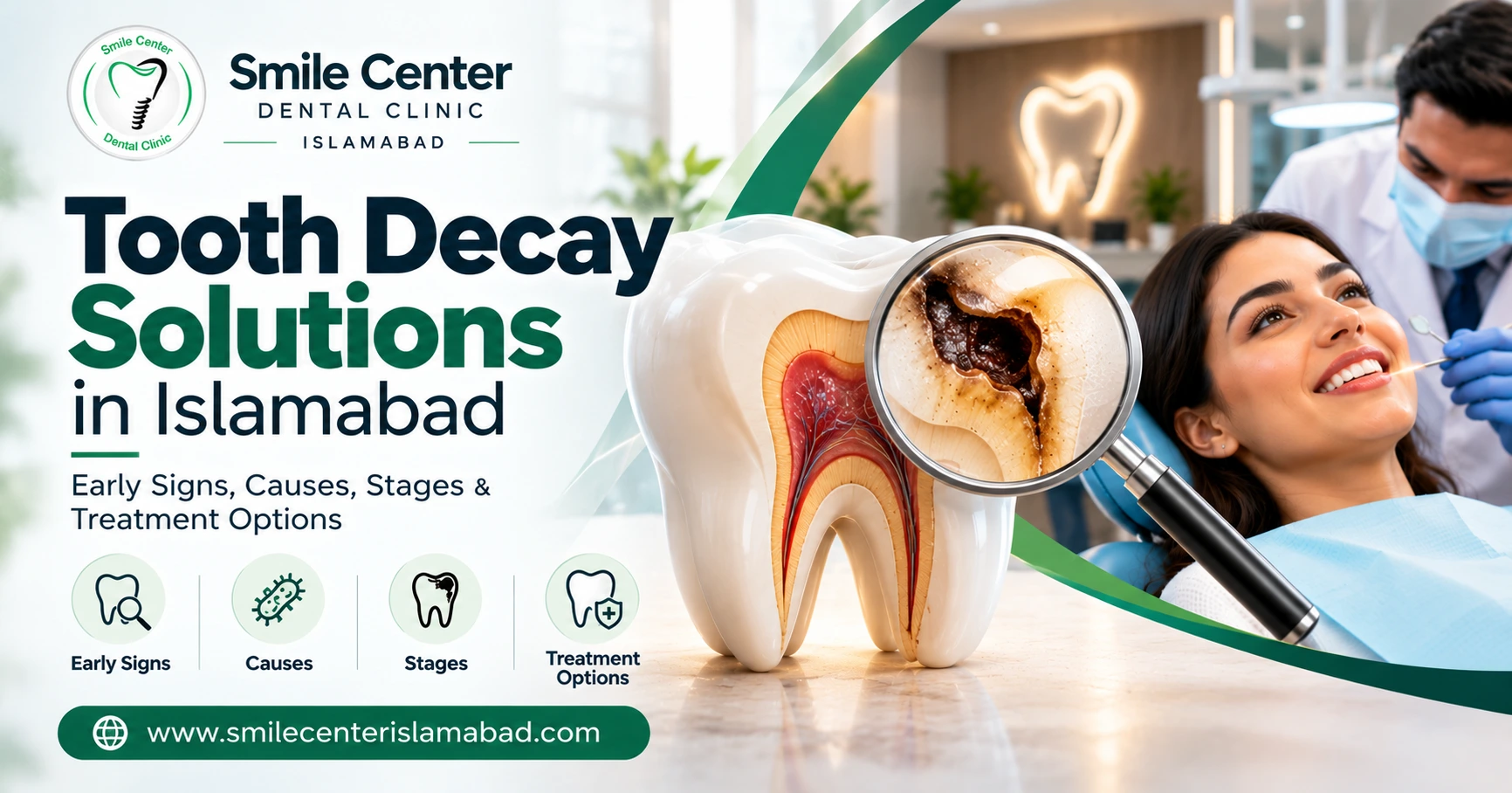
Tooth decay is one of the most common dental problems, and it can develop quietly before you notice any pain. A small area of mineral loss may eventually progress into a cavity, causing sensitivity, toothache, infection and, in severe cases, tooth loss. The good news is that early tooth decay can often be stopped or reversed before a cavity forms, while established cavities can usually be treated with appropriate dental care.
If you are experiencing a sensitive tooth, a visible dark or white spot, pain when eating sweets or drinking something cold, or a hole in your tooth, it is worth getting a professional dental assessment rather than waiting for the problem to become painful.
At Smile Center Dental Clinic Islamabad, patients can have their teeth assessed by qualified dental professionals and receive treatment based on the condition of the affected tooth. Smile Center currently operates five Islamabad branches in F-8, F-7, I-8, G-8 and Blue Area, making dental care more accessible for patients across the city.
What is Tooth Decay?
Tooth decay, also known as dental caries or cavities, is a progressive process in which acids produced by bacteria in dental plaque damage the hard tissues of a tooth.
Whenever you eat or drink foods containing sugars or starches, bacteria in plaque can use them to produce acids. Repeated acid attacks can remove minerals from the tooth's enamel. Saliva and fluoride help replace lost minerals, but when mineral loss continues, the enamel can weaken and eventually break down.
Early Signs of Tooth Decay
One of the biggest challenges with tooth decay is that early decay may not cause any noticeable symptoms. You can have developing decay even when your tooth does not hurt.
Possible early signs include:
- White or chalky spots on the tooth
- Brown or dark discoloration
- Increased sensitivity to cold or sweet foods
- Food frequently getting stuck in one area
- Roughness or changes in the tooth surface
- Mild discomfort when eating
- A visible pit or hole in the tooth
A white spot can represent mineral loss and may indicate an early stage of decay. At this point, the process may sometimes be stopped or reversed with appropriate preventive care and fluoride.
Don't wait for toothache
Many people make the mistake of assuming that a tooth is healthy because it does not hurt. Unfortunately, tooth decay can progress without pain. Regular dental examinations can identify problems before they become more extensive and difficult to treat.
What Causes Tooth Decay?
Tooth decay usually develops because several factors work together rather than because of one single food or habit.
1. Frequent sugar and starch consumption
Bacteria use sugars and fermentable carbohydrates to produce acids that attack enamel. Frequent snacking or regularly sipping sugary drinks can increase the number of acid attacks your teeth experience.
2. Inadequate brushing
Plaque is a sticky film containing bacteria. If it is not removed effectively, the bacteria continue producing acids that can damage teeth.
3. Not cleaning between teeth
Toothbrushes cannot effectively clean every surface between teeth. Plaque can accumulate in these areas and contribute to decay.
4. Low fluoride exposure
Fluoride helps strengthen enamel and can help prevent or arrest early tooth decay. Brushing with fluoride toothpaste is an important part of cavity prevention.
5. Dry mouth
Saliva naturally helps neutralize acids and provides minerals that help repair enamel. Reduced saliva flow can therefore increase the risk of tooth decay.
6. Certain medications or health conditions
Some medications and conditions can reduce saliva protection or otherwise increase cavity risk. Your dentist can take your medical history into account when assessing your risk.
7. Braces and dental appliances
Braces and some oral appliances can make certain areas harder to clean, potentially increasing plaque accumulation and cavity risk.
Tooth Decay Stages: How a Cavity Develops?
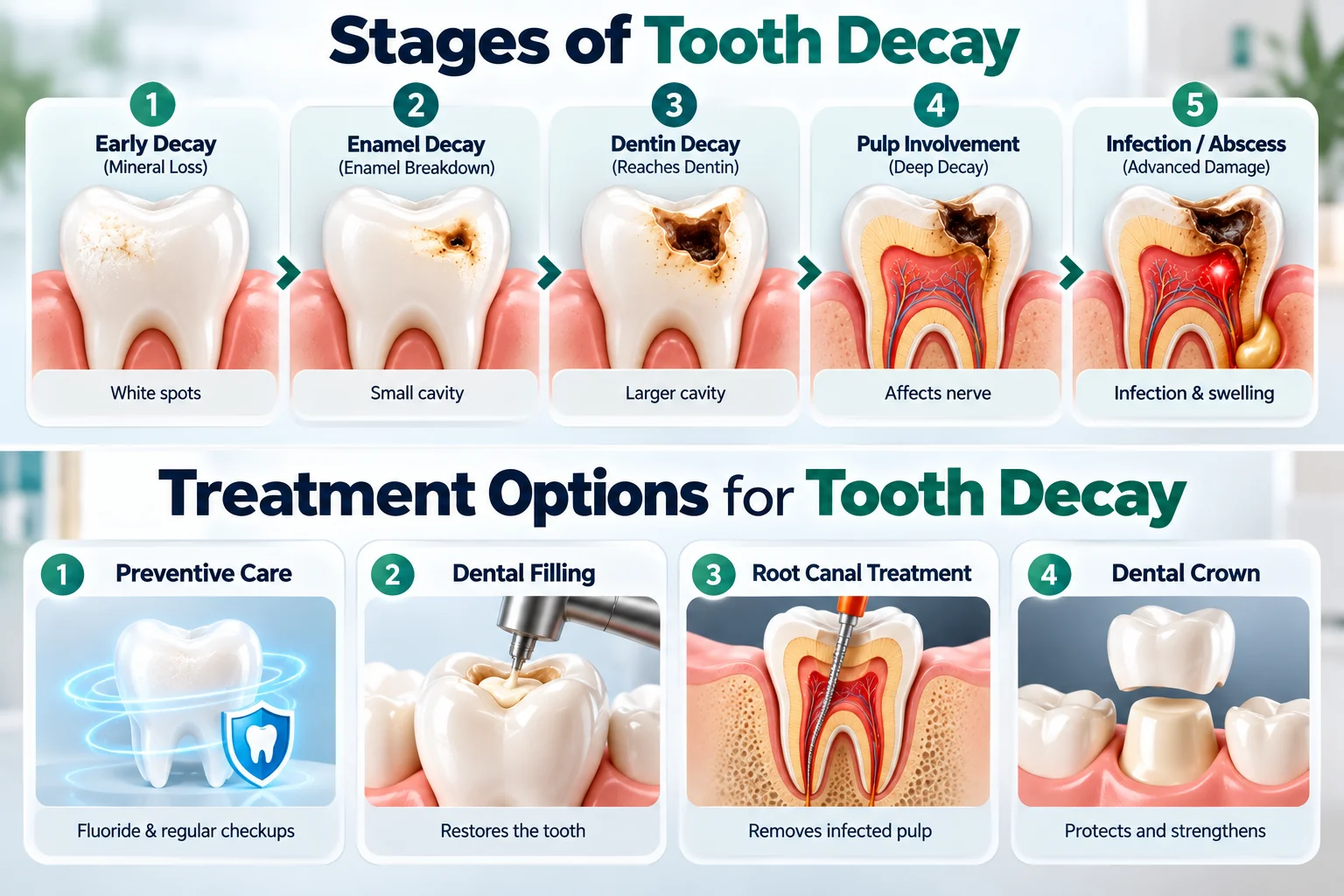
The progression of tooth decay can be simplified into several stages. These are useful for understanding the process, although the exact progression varies between patients.
Stage 1: Mineral Loss and Early Decay
The process begins when acids remove minerals from enamel. A white or chalky spot may appear. At this stage, there may be no pain or obvious symptoms.
Potential solution: professional assessment, fluoride and improved oral hygiene may help stop or reverse early mineral loss before a cavity forms.
Stage 2: Enamel Breakdown
If mineral loss continues, the enamel becomes weaker and can eventually break down.
Once a physical cavity or hole has formed, the damage is permanent and generally needs restorative treatment rather than simply relying on preventive measures.
Stage 3: Decay Reaches Dentin
Under the enamel is dentin, which is softer and more sensitive.
When decay reaches this layer, you may begin experiencing:
- Sensitivity to cold
- Sensitivity to sweets
- Pain while eating
- Increased food trapping
- A visible cavity
Treatment depends on how much tooth structure has been affected.
Stage 4: Decay Reaches the Pulp
The pulp is the living inner part of the tooth containing nerves and blood vessels.
When decay progresses deep enough to affect the pulp, symptoms may become more severe and treatment may require root canal treatment to remove diseased or infected pulp and save the tooth where possible.
You can learn more about Smile Center's approach to Root Canal Treatment in Islamabad.
Stage 5: Infection or Dental Abscess
If an infected tooth remains untreated, an abscess can develop.
Possible warning signs include:
- Severe or throbbing toothache
- Facial or gum swelling
- Pus around the tooth
- Fever
- Bad taste in the mouth
- Pain when biting
A dental infection should not be ignored. Significant facial swelling, difficulty swallowing or breathing requires urgent medical attention.
Can Tooth Decay Happen Without Pain?
Yes.
Early tooth decay commonly causes no symptoms. This is one reason routine dental examinations are important even if your teeth feel completely normal.
As decay progresses, symptoms can include:
- Toothache
- Sensitivity
- Pain from hot, cold or sweet foods
- Pain when biting
- Visible holes or pits
- White, brown or black discoloration
If you have persistent sensitivity or unexplained tooth pain, a dentist can examine the tooth and determine whether decay, a cracked tooth, gum recession or another dental problem is responsible.
Tooth Decay vs. Cavity: What's the Difference?
The terms tooth decay and cavity are often used interchangeably, but they describe slightly different things.
Tooth decay refers to the disease process that progressively damages the tooth.
A cavity is the hole or physical damage that can develop when the decay process progresses far enough.
In simple terms:
Tooth decay is the process; a cavity is one possible result of that process.
Early mineral loss may sometimes be stopped or reversed. Once a physical cavity has formed, however, the damaged tooth structure generally needs professional restoration.
When Does a Cavity Need a Dental Filling?
A dental filling is commonly used when tooth decay has created a cavity that needs restoration. During treatment, the dentist removes the decayed tooth tissue and restores the affected area with an appropriate filling material.
The exact treatment depends on:
- Size of the cavity
- Depth of decay
- Location of the tooth
- Remaining healthy tooth structure
- Whether the pulp is affected
- Your overall oral health
Smile Center provides dental fillings in Islamabad using restorative materials including tooth-coloured composite fillings. The clinic describes its approach as focused on preserving natural tooth structure while restoring the tooth's shape and function. =
Explore Dental Fillings in Islamabad at Smile Center.
When Does Tooth Decay Require Root Canal Treatment?
A root canal may be recommended when decay or other damage has reached the pulp and the tooth has become inflamed or infected.
Rather than removing the entire tooth, root canal treatment aims to remove the diseased pulp, clean and disinfect the root canals, and seal the tooth so it can be restored and used again.
Possible signs that a tooth may need root canal assessment include:
- Severe or persistent tooth pain
- Prolonged sensitivity to hot or cold
- Pain when biting
- Swelling around the tooth
- Deep decay
- A damaged or fractured tooth
- Darkening of the tooth
However, symptoms alone cannot determine whether you need a root canal. A dental examination and, where appropriate, X-rays are needed to establish the diagnosis.
Smile Center states that its root canal service is provided by FCPS-qualified endodontic professionals and uses digital imaging and rotary instrumentation as part of its treatment approach.
Can Tooth Decay Be Reversed?
Early tooth decay may be stopped or reversed before a cavity forms.
At the earliest stage, minerals are lost from enamel but the tooth has not yet developed a permanent hole. Saliva and fluoride can help the enamel regain minerals, and professional fluoride treatment may be recommended depending on the patient's risk.
Once a cavity has formed, however, the damaged tooth structure does not simply grow back. The dentist generally needs to restore the tooth with a filling or another appropriate treatment.
Tooth Decay in Children: Why Parents Should Act Early?
Children can develop cavities in both baby teeth and permanent teeth. Baby teeth still matter, and untreated cavities can cause pain and infection and interfere with eating, speaking and other everyday activities.
Parents should watch for:
- White or brown spots
- Visible holes
- Tooth sensitivity
- Toothache
- Difficulty chewing
- Food getting stuck around a tooth
- Swollen gums
- A child avoiding certain foods
Preventive dental care is particularly important during childhood. Fluoride, good brushing habits, appropriate dietary choices, dental examinations and professionally recommended preventive treatments can help reduce the risk of cavities.
Smile Center provides pediatric dentistry in Islamabad, including preventive care, fluoride and sealant treatments, children's dental examinations and cavity fillings.
Learn About Pediatric Dentistry at Smile Center.
What Happens If Tooth Decay is Ignored?
Ignoring a cavity does not make the underlying problem disappear.
As decay progresses, it can affect deeper parts of the tooth and potentially result in:
- Increasing sensitivity
- Persistent toothache
- A larger cavity
- Tooth fracture or weakening
- Pulp infection
- Dental abscess
- Tooth loss
Untreated cavities can progress into more serious infections, which is why early assessment is preferable to waiting until pain becomes severe.
How to Prevent Tooth Decay?
You can significantly reduce your risk of cavities by making oral hygiene and preventive dental care part of your routine.
- Brush twice a day
Use fluoride toothpaste and brush thoroughly, paying attention to all tooth surfaces.
- Clean between your teeth
Use floss or another appropriate interdental cleaner to remove plaque from areas a toothbrush cannot reach.
- Reduce frequent sugary snacks and drinks
The frequency of acid attacks matters, so avoid constantly sipping sugary beverages or repeatedly snacking throughout the day.
- Don't ignore sensitivity
Sensitivity can have several causes, including decay. If it persists, have the tooth examined rather than repeatedly treating the symptom at home.
- Maintain regular dental checkups
A dental examination can identify cavities and other oral-health problems before they become more complicated.
Smile Center's routine dental checkup includes examination of the teeth and gums, professional cleaning, oral-health guidance and digital X-rays when clinically necessary.
Book a Routine Dental Checkup in Islamabad.
When Should You See a Dentist in Islamabad?
You should arrange a dental examination if you notice:
- Persistent toothache
- Sensitivity that keeps returning
- A visible hole in your tooth
- White, brown or black spots
- Pain when biting
- Swelling around a tooth
- Bleeding or swollen gums
- Bad taste or pus around a tooth
- A broken or damaged tooth
- A child complaining of tooth pain
Seek urgent dental care if you have significant swelling, severe dental pain, a dental injury or signs of infection. If swelling is affecting breathing or swallowing, seek immediate emergency medical care.
Get Emergency Dental Treatment in Islamabad.
Tooth Decay Treatment in Islamabad: What Should You Expect?
The right treatment cannot be determined simply by looking at your symptoms.
At a dental appointment, the dentist may:
- Ask about your symptoms and dental history.
- Examine your teeth and gums.
- Check for visible signs of decay.
- Assess sensitivity or affected areas.
- Take dental X-rays when necessary.
- Determine how deep the decay has progressed.
- Explain the available treatment options.
- Develop an appropriate treatment plan.
Depending on the condition of the tooth, treatment could include preventive care, fluoride treatment, a dental filling, a crown, root canal treatment or extraction in cases where the tooth cannot be restored.
Why Choose Smile Center for Tooth Decay Treatment in Islamabad?
Choosing the right dental clinic is about more than simply finding a dentist who can fill a cavity. The goal should be to identify the cause, preserve healthy tooth structure where possible and choose treatment appropriate to your individual condition.
Smile Center Dental Clinic currently highlights:
- FCPS and MDS-qualified dental specialists
- Modern dental technology including digital X-rays
- Restorative and preventive dental care
- Root canal treatment by qualified endodontic professionals
- Pediatric dental services
- Multiple locations across Islamabad
- Clear treatment planning and patient education
- Online appointment booking
The clinic currently lists five Islamabad branches: F-8, F-7, I-8, G-8 and Blue Area.
Book a Dental Appointment at Smile Center Islamabad.
Frequently Asked Questions about Tooth Decay
What is the main cause of tooth decay?
Tooth decay develops when bacteria in dental plaque produce acids that repeatedly attack the tooth. Frequent exposure to sugars and starches, inadequate plaque removal and other risk factors can contribute to the process.
Can tooth decay go away on its own?
Very early mineral loss may be stopped or reversed with appropriate preventive care. Once a true cavity has formed, the damaged tooth structure generally requires professional restoration.
Can you have tooth decay without pain?
Yes. Early tooth decay often causes no symptoms. Pain and sensitivity may appear as the decay becomes more advanced.
Is a cavity the same as tooth decay?
Not exactly. Tooth decay describes the disease process, while a cavity is the hole or structural damage that can result when the process progresses.
Does every cavity need a root canal?
No. Treatment depends on how deep the decay is. A smaller cavity may be restored with a filling, while decay affecting the pulp may require root canal treatment.
Can tooth decay be treated without removing the tooth?
Often, yes. Depending on the condition, dentists may use preventive treatment, fillings, crowns or root canal treatment to preserve the natural tooth. Extraction is generally considered when a tooth cannot be predictably restored.
Is tooth decay common in children?
Yes. Children can develop cavities in both baby and permanent teeth. Early prevention and dental visits can help identify and manage problems before they become more serious.
How can I prevent tooth decay?
Brush twice daily with fluoride toothpaste, clean between your teeth, limit frequent sugary foods and drinks, and maintain regular dental examinations.
How do dentists diagnose tooth decay?
A dentist may examine your teeth, ask about symptoms, assess areas of concern and use dental X-rays when needed to identify decay that may not be visible during a routine examination.
Don't Wait for Tooth Decay to Become Painful
Tooth decay does not always announce itself with a toothache. A small white spot, occasional sensitivity or a minor cavity can be an early warning that something needs attention.
Getting the problem assessed early can give you more opportunity to protect your natural tooth and may help avoid more extensive treatment later.
If you are looking for tooth decay treatment in Islamabad, Smile Center Dental Clinic provides dental examinations, fillings, root canal treatment, pediatric dentistry and emergency dental care across its Islamabad locations.
Book Your Appointment at Smile Center Dental Clinic Islamabad.